Can You Get a Car Loan With No Credit History in Australia?
Many Australians have no credit history. Maybe you’ve only ever used a debit card, you’ve just moved here, or you’re buying your first car at 19. None of that automatically rules you out of car finance, but it does change how lenders look at your application.
Below, we cover how lenders evaluate a blank credit file, which loan options to explore, how to strengthen your application, and how rent-to-own cars work if a loan doesn’t pan out.
Can you get a car loan with no credit history?
Yes, it’s possible, but it’s harder. With no credit history, lenders can’t see how you’ve managed repayments, so they rely more on your income, employment, savings and deposit. You may need a guarantor, a secured loan or a larger deposit, or you could consider an alternative like a rent-to-own car.
Whether you’re approved depends on the lender’s criteria and your overall financial situation. Two people with no credit history can get very different outcomes. Someone with steady full-time income and savings is usually in a stronger position than someone with irregular income and no deposit.
What does “no credit history” mean?
Having no credit history means there’s little or no information about you on file with Australia’s credit reporting bodies. This is sometimes called a “thin” credit file.
Your credit report records things like credit applications, credit limits and your repayment history. If you’ve never had a credit card, personal loan, car loan or similar account, there may be nothing for a lender to review.
No credit history vs bad credit
No credit history and bad credit are not the same thing. Lenders see them very differently.
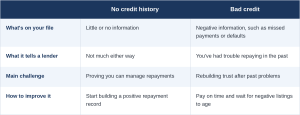
Once you have a credit file, your score becomes one factor in car loan approval.
Who often has no credit history?
You’re more likely to have little or no credit history if you are:
- A first-time driver who hasn’t needed credit yet
- New to Australia, because overseas credit history generally doesn’t carry over. This includes international students weighing up car loan options and temporary visa holders looking at rent-to-own
- Someone who uses cash or debit only and has avoided credit cards and loans
- An Australian returning from years overseas, whose local file may have little recent activity
How to check your credit report for free
Before you apply anywhere, find out what’s actually on your file. Australia has three main credit reporting bodies: Equifax, Experian and illion.
Each one will give you a free copy of your report, generally every three months. They don’t always hold the same information, so get all three.
You might be surprised. Some postpaid phone and utility accounts can show up on a credit report, so you may have more history than you realise.
Why lenders find no credit history hard to assess
Lenders find no credit history hard to assess because they have no track record showing how you handle repayments. They have to rely on other evidence instead.
In Australia, licensed lenders have responsible lending obligations. In plain terms, they must make reasonable enquiries about your financial situation and check that a loan isn’t unsuitable for you.
A credit report is one of the main tools lenders use for this. Without one, they’ll look more closely at:
- Income: how much you earn and how you’re paid
- Employment: how long you’ve been in your job and whether it’s full-time, part-time, casual or self-employed
- Living expenses: what you spend each month, often checked against bank statements
- Savings: whether you’ve been able to save regularly
- Existing commitments: rent, buy now pay later accounts and other bills
- Residency status: for some lenders, whether you’re a citizen, permanent resident or visa holder
This isn’t the same as being judged negatively. It just means the rest of your application has to do more of the work.
Car loan options when you have no credit history
If you want a car loan, you have several options to explore. Each has trade-offs, so compare the full cost and conditions before you apply.
Banks and credit unions you already use
Your own bank or credit union can see your account activity, such as regular pay deposits and savings. That relationship may help when there’s nothing on your credit file. Some credit unions and mutual banks are also known for more personalised assessments.
Secured car loans
With a secured car loan, the car is used as security for the loan. If you don’t make repayments, the lender can repossess it. Because the lender carries less risk, secured loans can be easier to access and may have lower rates than unsecured personal loans.
Guarantor car loans
A guarantor, usually a parent or close family member, agrees to cover the loan if you can’t. This can strengthen an application with no credit history.
It’s a serious commitment for the guarantor. If you miss repayments, they become legally responsible for the debt. Their own credit file and assets may be affected. Both of you should understand the agreement fully, and the guarantor may want independent legal advice.
Dealer finance
Many car dealers arrange finance through partner lenders. It’s convenient, but don’t judge it on the weekly repayment alone. Compare the comparison rate, which includes most fees and charges, against other lenders.
Specialist and non-bank lenders
Some non-bank lenders work with applicants who don’t fit standard bank criteria. They may be more flexible, but interest rates and fees can be higher. Read the contract carefully and check the lender holds an Australian Credit Licence.
How to improve your chances of approval
When there’s no credit history to lean on, everything else in your application has to pull its weight. Here’s where to focus.
- Have proof of income ready. Think recent payslips, bank statements or tax returns. If you’re self-employed, you may need business activity statements or financials from your accountant.
- Build up some savings. A few months of regular deposits show a lender you can stick to a plan.
- Put down a deposit. The more you pay upfront, the less you borrow and the less risk the lender carries.
- Clear out other commitments. Close buy now, pay later accounts you’re not using and pay down what you can. BNPL habits can affect car finance approval more than many people expect.
- Pick a car you can comfortably afford. A smaller loan is easier to get approved and easier to live with.
- Don’t apply everywhere at once. Applications can show up on your credit report, and a cluster of them can make lenders wary. Do your homework, then apply where you have a real shot.
- Get your paperwork straight. Your ID, address and residency documents should be current and match each other.
Rent-to-own cars: an alternative to a car loan
If a car loan isn’t available to you, or doesn’t feel like the right fit, a rent-to-own car is one alternative to consider. It works differently from a loan, so it’s important to understand how.
What is a rent-to-own car?
A rent-to-own car is a vehicle you pay for in regular instalments over an agreed term, without taking out a car loan. You don’t own the car during the term. At the end, you may have an option to purchase it, subject to approval and the agreement’s terms.
How rent-to-own works at CarCoop
The process is designed to be straightforward:
- Pre-qualify online. Answer a few questions to see whether you may be eligible.
- Complete your application. CarCoop assesses your circumstances against its requirements.
- Choose a vehicle. If approved, choose from available late-model vehicles that suit your situation. Availability changes over time.
- Agree on a term. Terms can include 2 or 4 years, depending on the agreement.
- Drive and make regular payments. Keep up your payments for the term of the agreement.
- Review your end-of-term options. You may have an option to purchase the car, subject to CarCoop’s approval and applicable terms. Depending on the agreement, other options can include returning the vehicle or exploring an upgrade.
Depending on the agreement and vehicle, your regular payment can include registration, CTP insurance, comprehensive insurance, scheduled servicing and roadside assistance. Check exactly what’s included in your agreement before you sign.
Who rent-to-own may suit
Rent-to-own may suit drivers who find it hard to access traditional finance, including people with:
- No credit history or a limited credit history
- Casual or self-employed income
- Recent arrival in Australia, such as international students
- Pension income
Belonging to one of these groups doesn’t mean automatic approval. Rent-to-own eligibility criteria still apply.
Things to weigh up
Rent-to-own has real benefits, but it’s not right for everyone. Consider these points:
- You don’t own the car during the term. You’re using the vehicle under the terms of the agreement.
- Total cost matters. Over the full term, you may pay more than the car’s purchase price. Compare the total amount payable, not just the weekly payment.
- Ownership isn’t guaranteed. Any option to purchase at the end is subject to approval and conditions.
- Included costs can offset the price. If rego, insurance and servicing are included, factor that in when comparing with a loan.
For a balanced look, read our guide to the pros and cons of rent-to-own.
How to start building credit history
You build credit history by using credit responsibly and making repayments on time, every time. Building a stronger credit profile takes time, so it’s worth starting early, even if you don’t need finance yet.
Practical ways to start include:
- Pay household bills on time. Some postpaid phone and utility accounts can be reported on your credit file.
- Consider a low-limit credit card only if you can pay the balance in full each month.
- Keep your details consistent. Use the same name and address details across your accounts.
- Check your credit report regularly to make sure the information is accurate.
- Don’t overcommit. Taking on too much credit can work against you.
Frequently asked questions
Is having no credit history the same as bad credit?
No. No credit history means there’s little or nothing on your credit file. Bad credit means your file shows negative information, such as missed payments or defaults. Lenders treat the two situations differently.
Can I rent to own a car with no credit history?
It may be possible. Rent-to-own providers like CarCoop assess applicants against their own eligibility requirements, so having no credit history doesn’t automatically rule you out. Approval isn’t guaranteed and depends on your circumstances.
Do you own the car with rent-to-own?
Not during the term. With CarCoop’s rent-to-own option, the car is provided under a consumer lease. At the end of the term, you may have an option to purchase it, subject to approval and applicable terms.
Does applying for a car loan affect my credit file?
It can. A credit application may be recorded on your credit report as an enquiry. Several applications in a short time can make lenders cautious, so compare options before you apply.
How long does it take to build credit history?
There’s no fixed timeframe. Your history builds as you hold accounts and make on-time repayments. The longer you show consistent repayments, the more information lenders have to assess.
The bottom line
You can get a car loan with no credit history in Australia, but you’ll usually need to show stronger evidence in other areas. Steady income, a savings record and a deposit all help. A guarantor or secured loan may also open more doors.
If a loan isn’t the right fit, a rent-to-own car is another way to get on the road. Just make sure you understand the total cost, what’s included and your options at the end of the term.
Want to see where you stand? Check if you pre-qualify with CarCoop, or learn more about our rent-to-own car options.