How Does Car Leasing Work in Australia? A Practical Guide
Getting a car doesn’t always mean taking out a loan and owning it from day one.
For some Australian drivers, leasing can provide another way to access a vehicle while spreading the cost across regular payments. The catch is that “car leasing” can mean different things, and the arrangement you enter can significantly affect what you pay, what is included and what happens when the agreement ends.
So, how does car leasing work?
In simple terms, you use a vehicle under a lease agreement for an agreed period and make regular payments for that use. However, the details depend on the type of lease, the provider and the contract.
What is car leasing?
Car leasing in Australia is a contractual arrangement where a driver pays a leasing provider regular fees to use a vehicle over a set term. The lease term depends on the type of lease and the provider, and can vary from one agreement to another.
Instead of paying the full purchase price upfront, you make regular payments throughout the lease term. Depending on the arrangement, payments may be weekly, fortnightly or monthly.
The exact structure of a car lease can vary significantly between providers, so it’s important to understand whether you’re looking at a consumer lease, novated lease or another vehicle arrangement.
That’s why comparing the payment alone can be misleading. Two vehicles advertised at a similar weekly cost may have very different inclusions and conditions.
How does the car leasing process work step-by-step?
Although lease structures vary, the process usually follows a straightforward path.
1. Fill Out the Form
Start by completing the application or pre-qualification form with your basic personal, income and expense details.
2. Discuss Your Application
A team member contacts you to discuss your application, answer your questions and explain the next steps.
3. Choose Your Vehicle
Once you’re eligible, you can browse and choose a suitable vehicle based on your need, budget and available options.
4. Agree to the lease terms
Before signing, you’ll generally see details such as the lease term, payment amount, vehicle details, fees and responsibilities.
This is the point where you should slow down and read the agreement rather than focusing only on the advertised payment.
5. Make regular payments and use the vehicle
Once the agreement begins, you make payments according to the schedule and use the vehicle under the conditions of the lease.
Depending on the product, some running costs may be included. Others remain your responsibility.
What happens when the lease ends?
This is where many people misunderstand car leasing.
Finishing the payments does not automatically mean you own the vehicle.
For a consumer lease, the provider generally remains the owner unless the agreement provides for another outcome. ASIC describes consumer leases as arrangements where a consumer rents an item for a set period and makes regular repayments.
The exact end-of-lease options depend on your agreement.
You may be able to:
- Return the vehicle
- Enter another agreement
- Upgrade, where offered
- Request a transfer of ownership, where applicable
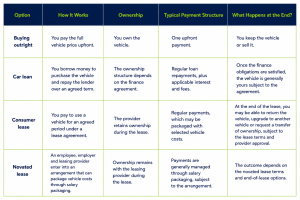
A consumer lease is one example of a vehicle leasing structure, with terms that can differ from traditional car loans, hire purchase arrangements and novated leases. Customers do not automatically own the vehicle during a consumer lease. Where a provider allows an ownership transfer at the end of the agreement, the process and conditions depend on the provider and lease terms.
That’s why reading the end-of-lease section before signing is just as important as checking the weekly payment.
Car Leasing vs Buying vs Car Loans vs Novated Leases
What can be included in lease payments?
This varies considerably between providers.
Depending on the product, a vehicle package may include some combination of:
- Registration
- Insurance
- Scheduled servicing
- Roadside assistance
- Other agreed vehicle-related costs
This can simplify budgeting because several recurring vehicle costs are incorporated into the payment structure.
Still, always check exactly what is included. Fuel, tolls, fines, repairs outside the agreed servicing arrangements and other costs may remain your responsibility.
Who is eligible to lease a car in Australia?
Leasing can be worth researching if you want access to a vehicle without immediately purchasing one outright.
It may also be relevant to casual workers, contractors, self-employed Australians or people who have found traditional finance difficult to access.
That doesn’t mean every applicant will qualify. Providers can have their own eligibility and affordability assessments, and the terms of the agreement matter just as much as approval.
The right question isn’t simply, “Can I get approved?”
It’s “Can I comfortably manage this agreement for its entire term?”
5 things to check before signing a car lease
Before committing, take a few minutes to check the details carefully.
1. Calculate the total cost
Multiply the regular payment by the number of payments, then add upfront costs and any other applicable charges. A low weekly figure can look attractive until you see the complete cost.
2. Understand what is included
Confirm whether registration, insurance, servicing and roadside assistance are included or charged separately.
3. Read the end-of-lease terms
Find out whether you return the vehicle, can upgrade, or have any opportunity to request ownership transfer. Don’t rely on verbal explanations.
4. Check your responsibilities
Understand who pays for fuel, tolls, damage, maintenance, excesses and other running costs.
5. Make sure the payment fits your budget
A vehicle payment should work alongside rent, groceries, utilities, insurance and other regular expenses. If the payment only works when everything goes perfectly, the agreement may be too expensive.
Frequently Asked Questions
- Is leasing a car the same as buying one?
No. With a lease, you pay to use the vehicle during the agreement rather than owning it outright from the beginning. Ownership arrangements depend on the specific lease terms. - What happens when a car lease ends?
The outcome depends on the agreement. You may be able to return the vehicle, enter another agreement, upgrade, or request an ownership transfer where available and approved. - Can you lease a car with bad credit?
Some consumer lease providers may consider applicants who have difficulty accessing traditional car finance. However, eligibility varies between providers, and applicants still need to meet applicable affordability and eligibility requirements. - Is car leasing cheaper than buying?
Not necessarily. The overall cost depends on the lease terms, payment amount, inclusions, fees and how long you keep the vehicle. It’s important to compare the total cost rather than looking only at the regular payment.
Is car leasing right for you?
Choosing between leasing and buying comes down to your budget, priorities and how you want to use a vehicle. Understanding the financial benefits of leasing a car vs buying, along with the total costs and responsibilities of each option, can help you make a more informed decision.
If predictable payments, manageable upfront costs or packaged vehicle expenses are important to you, leasing may be worth considering. However, always review the lease term, inclusions, ongoing costs and end-of-lease arrangements before signing an agreement.
If you want to take the next step, you can pre-qualify in 60 seconds with CarCoop. Eligibility and affordability requirements apply.
The right choice is ultimately the one that fits your circumstances, gives you a clear understanding of the agreement and allows you to manage the vehicle costs comfortably throughout the lease term.